10 Small Home Office Ideas for a Corner
When I started working from home, I bought a 60-inch desk for a 48-inch corner. I measured the wall, but I didn’t measure the baseboard heater, the door swing, or the fact that my chair needed 24 inches to roll back. The desk went in sideways, and after a month working from the sofa with a laptop on my knees, my back gave up first. I sold the desk for half what I paid. That’s when I learned the rule for a corner office: the corner decides the desk, not the other way around.
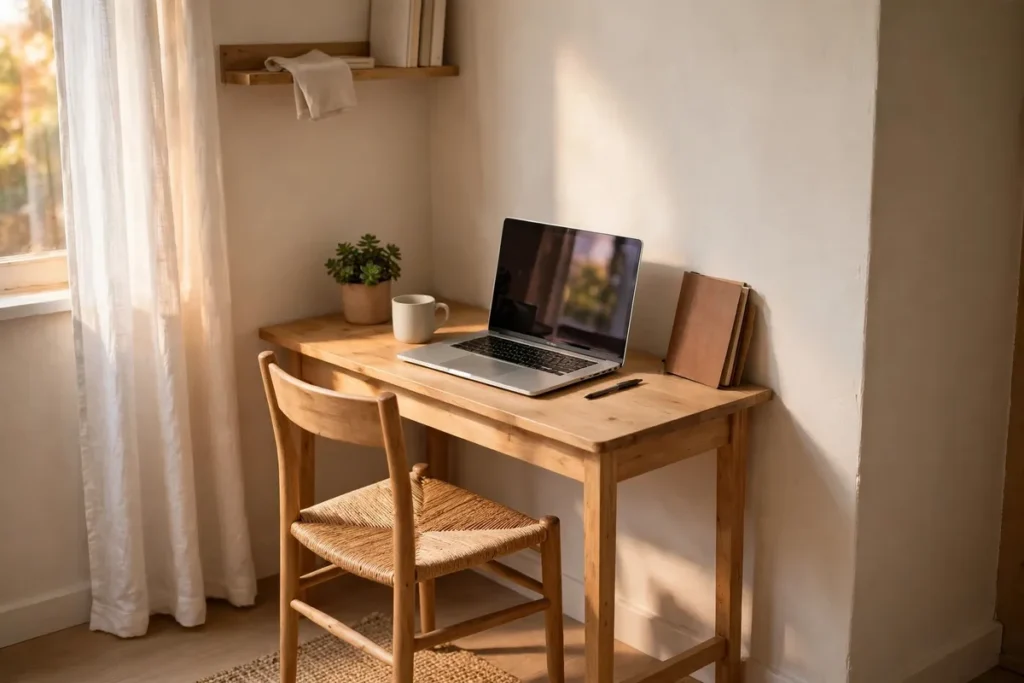
A corner is the best office a small apartment has — it’s dead space anyway, it’s out of the walkway, and one wall blocks the rest of the room from view on video calls. These 10 ideas are renter-friendly, made for a corner, and built around a starter budget of around $200. No drilling, no renovation, no landlord problems.
1. Measure the corner before you buy anything
Measure three things: both walls, and the space your chair needs to roll back — about 24 inches behind the desk. A corner desk 42–48 inches wide fits most apartment corners; a standard desk 20–24 inches deep leaves room to breathe. Tape the numbers to the wall before you shop. If the desk doesn’t fit the tape, it doesn’t fit the corner.
2. Pick a small desk, not a big one
A corner doesn’t need a big desk — it needs the right desk. A simple writing desk 42 inches wide, a wall-mounted fold-down desk that closes flat when you’re done, or a narrow console table all work. Around $60–$100 for a small desk, $40–$70 for a fold-down one. One drawer is enough; three drawers eat the leg room. If the desk has a keyboard tray, that’s a bonus — it frees up 6 inches of desk surface you actually use.
3. Face the desk toward the room
Most people push the desk into the corner and face the wall. Flip it: put the desk against one wall and sit facing into the room, with the corner behind you. You get natural light on your face instead of a wall, the room feels bigger because you can see it, and on video calls the background is your living room, not a blank corner. If the window is on the side wall, angle the desk so the light comes from the side — never from directly behind you, or you’ll be a silhouette.
4. Put one shelf above the desk
One floating shelf, about 24–30 inches long, mounted with adhesive brackets or a no-drill rail, holds the books, the notebook and the plant — and gets them off the desk. Around $15–$25. Keep it at arm’s reach, about 18 inches above the desk surface, so you can grab things without standing up. Two shelves look like storage; one shelf looks like design.
5. Spend the money on the chair, not the desk
A $60 desk and a $100 chair beats a $150 desk and a dining chair every time. Your chair needs a seat 17–19 inches high, a backrest that reaches your shoulder blades, and wheels that roll on your floor — hard wheels for a rug, soft wheels for wood. Around $60–$120 for a decent task chair. Sit in it before you buy it, and check the return policy if you can’t. Your back will notice the chair on day one and the desk on day thirty.
6. Light the corner like a workspace, not a bedroom
One overhead light makes a corner feel like a cave. Put a desk lamp on the side your mouse hand isn’t on — left side if you’re right-handed — with a warm white bulb, 2700–4000K, around 800 lumens. Around $15–$25. If the corner is near a window, that’s your main light during the day; the lamp is for evenings. A cheap clip-on light on the shelf works too, and it leaves the whole desk free.

7. Tame the cables on day one
Cables multiply in a corner because everything is plugged in behind you where you can’t see it. One power strip with a 6-foot cord, three adhesive cable clips under the desk edge, and one labeled cable for each device. Around $10–$15 total. Run the strip along the baseboard, clip the cables to the desk leg, and label the chargers you use daily. Twenty minutes now saves you from crawling under the desk every time something comes unplugged.
8. Build a wall between work and home
A corner office has one problem: you can see your bed from your desk. A folding screen, a tall plant, or a curtain on a tension rod between the desk and the room draws the line. Around $20–$40 for a folding screen or a tension rod plus a curtain panel. Screen up, you’re at work; folded away, the apartment is yours again — and the desk stays hidden from the living room.
9. Soften the sound
Corners echo. A small rug under the desk and chair — about 3 by 5 feet, around $15–$25 — kills the echo and stops the chair wheels from scratching the floor. Add a cushion on the chair and a fabric pinboard on the wall, and the corner stops sounding like an empty room. For calls, headphones beat a $100 microphone in a bare corner. If your walls are thin, the rug and the headphones together do more than any foam panel.
10. End the day with a 5-minute shutdown
A corner office fails when work never ends, because the desk is always there. Every evening, take five minutes: clear the desk to one notebook and one pen, write down tomorrow’s top three tasks on a sticky note, close the laptop, and turn the chair toward the room. Around $0. That closed laptop is the signal — the office is shut, the apartment is home again. The corner works because it closes.

The $200 Corner Office Starter Kit
One realistic way to spend it:
- Small desk, 42 inches wide: ~$80
- Task chair with lumbar support: ~$60
- Desk lamp, warm white: ~$20
- Floating shelf, 24–30 inches: ~$15
- Power strip + cable clips: ~$10
- Small rug, 3 by 5 feet: ~$15
- Total: ~$200 — and all of it moves with you to the next rental.
Start with the tape measure, the desk and the chair. Those three cost about $140 and decide whether the corner works at all.
Small Home Office FAQ
How much space do I need for a home office in a corner?
About 48 inches of wall and 24 inches of chair room behind the desk. A desk 42–48 inches wide and 20–24 inches deep fits most apartment corners — measure the wall, the baseboard heater and the door swing before you buy.
Can I set up a home office in a rental without drilling?
Yes. A freestanding desk, adhesive shelf brackets or a no-drill rail, adhesive cable clips, a tension-rod curtain and a folding screen — nothing on this list needs a hole in the wall. My 10 Renter-Friendly DIY Upgrades (No Drill Needed) has more no-drill ideas that work in an office corner.
What’s the cheapest way to set up a small home office?
A small used desk, a decent chair, and a lamp — around $100–$140 secondhand. Spend on the chair first; the desk can be simple. If your corner is in the living room, my Small Living Room Layout Ideas That Actually Work shows how to place it without blocking the walkway.
Small home office numbers that matter
- 42–48 inches: the width of a corner desk that fits most apartment corners. Measure both walls and the door swing before you shop — I bought a 60-inch desk for a 48-inch corner.
- 20–24 inches: desk depth. Shallower than 20 and your laptop hangs off the edge; deeper than 24 and the desk eats the room.
- 24 inches: the chair room you need behind the desk to roll back and stand up. Measure it, or you’ll hit the wall every time.
- 29–30 inches: standard desk height. If your desk is much higher or lower, your shoulders will tell you within a week.
- 17–19 inches: chair seat height. Your feet should rest flat on the floor with your knees at about 90 degrees.
- 20–26 inches: screen distance from your eyes, with the top of the screen at eye level. A stack of books under a laptop gets you there for $0.
- 800 lumens: a desk lamp bright enough to work by, warm white 2700–4000K. One lamp on the opposite side from your mouse hand.
- 5 minutes: the shutdown ritual — clear the desk, write tomorrow’s top three, close the laptop, turn the chair. That’s what makes a corner office feel like an office, not a desk that never lets you go home.
What to Skip
Skip the giant L-shaped desk — it eats the corner and the room, and you’ll use one side of it. Skip buying a chair without sitting in it or checking the return policy; a bad chair costs more in back pain than a good one costs in dollars. Skip working from the sofa or the bed — the laptop on your knees feels fine for a day and ruins your neck for a month. Skip the matching office set: a desk, chair, shelf and lamp bought as a set costs more than the same pieces bought separately, and the set never fits your corner anyway. And skip putting the desk facing the wall in a dark corner — light and a view are free, and they decide whether you’ll actually sit there.
A corner office doesn’t need a spare room. It needs a desk that fits, a chair that supports you, light from the side, and a shutdown ritual that gives you your apartment back at night.
Start tonight, with the tape measure. Tomorrow, the desk.
About the author: Woodjinald Emmanuel runs Lite Habitats, a blog about decorating small spaces on a budget. He started it to show that a small home can feel beautiful without spending a fortune.